Admissions open for 2026–2027. Up to ₹10,000 off for early admissions. Limited seats available
Montessori, Play-Based, or Structured Learning: What Really Works for 2–4 Year Olds?
One of the most confusing decisions parents face in the early years is choosing the right learning approach for their child. Montessori schools promise independence, play-based preschools talk about learning through joy, while structured programs focus on early academics and discipline. As parents of two- to four-year-olds, it is natural to wonder which approach truly supports your child’s development and prepares them for the future. The truth, supported by early childhood research, is more nuanced than choosing one label over another.
1/14/20263 min read
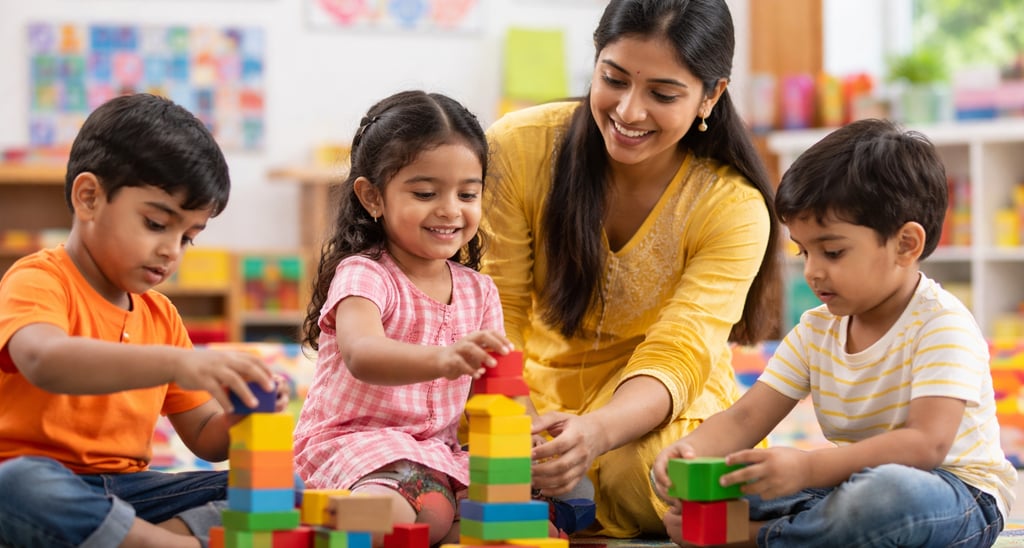

Between the ages of two and four, a child’s brain is in its most rapid phase of development. Neural connections responsible for emotional regulation, language, social interaction, and curiosity are being formed every single day. Research in early childhood development consistently shows that how a child learns during these years matters far more than what they are taught. This is why understanding the difference between Montessori, play-based learning, and structured learning becomes so important.
Montessori education is often associated with independence, order, and hands-on materials. In a true Montessori environment, children are encouraged to choose activities, work at their own pace, and develop concentration through repetition. For two- to four-year-olds, Montessori methods can be extremely effective when they are developmentally adapted. At this age, children benefit from practical life activities, sensorial exploration, and freedom within limits. However, research also cautions that Montessori environments must be emotionally responsive. Independence should never be confused with isolation. Young children still need warmth, guidance, and reassurance to feel secure while exploring independently.
Play-based learning, on the other hand, aligns closely with what child development research tells us about how young children naturally learn.
Play is not a break from learning; it is the primary way the brain integrates information in early childhood.
Through play, children develop language, problem-solving skills, emotional regulation, and social understanding. When a child pretends, builds, explores, or engages in imaginative play, multiple areas of the brain are activated simultaneously. Studies show that play-based preschool environments support stronger long-term outcomes in creativity, communication, and emotional resilience. For children between two and four, play-based learning supports natural curiosity without pressure, making learning feel safe and enjoyable.
Structured learning environments often appeal to parents who worry about school readiness and future academic performance. These programs focus on routines, worksheets, early literacy, numbers, and teacher-led instruction. While structure itself is not harmful, research clearly shows that excessive academic pressure in the early years can backfire. Children under four are still developing the ability to sit for long periods, follow abstract instructions, and manage performance expectations. When structured learning dominates too early, it can lead to stress, resistance to learning, reduced curiosity, and even behavioural challenges. This does not mean routines are unnecessary. Predictable routines provide emotional safety, but structured academics should never replace exploration and play at this age.
So what really works for two- to four-year-olds? Research increasingly supports a balanced, developmentally appropriate approach. Children thrive in environments where emotional safety comes first, where play is respected as a learning tool, where independence is encouraged gently, and where structure exists to support, not control the child. The most effective early learning environments borrow the best elements of Montessori, play-based learning, and gentle structure without rigidly following one label.
For example, a well-designed preschool for this age group may use Montessori-inspired materials for hands-on exploration, allow ample time for free and guided play, and follow a predictable daily rhythm that helps children feel secure. In such environments, teachers act as facilitators rather than instructors, observing children closely and responding to their developmental needs. Learning happens through movement, conversation, sensory experiences, and emotional connection rather than forced outcomes.
Another crucial factor often overlooked in this debate is emotional readiness. No learning method, whether Montessori, play-based, or structured, can be effective if a child does not feel emotionally safe. Research in early childhood psychology shows that stress inhibits learning. A child who is anxious, rushed, or fearful cannot engage deeply with any curriculum. This is why emotionally responsive environments consistently outperform academically rigid ones in long-term outcomes. Children who feel secure develop confidence, self-regulation, and a genuine love for learning.
Parents often ask which method will prepare their child best for formal schooling. Studies suggest that children who experience play-based and emotionally supportive early education adapt better to later academic demands. They show stronger problem-solving abilities, better social skills, and healthier attitudes toward learning. Early exposure to academics does not guarantee academic success, but early exposure to emotional safety and curiosity does.
At InuPinu Preschool and Daycare, we believe the question should not be whether Montessori, play-based, or structured learning is better. The real question is whether the environment respects how young children actually grow and learn. For two- to four-year-olds, the most effective learning happens when children feel safe, seen, and supported. When learning feels joyful rather than pressured, outcomes follow naturally.
Choosing the right preschool approach is not about trends or labels. It is about understanding your child’s developmental needs and choosing an environment that honours childhood. When emotional safety, play, gentle independence, and supportive structure come together, learning becomes meaningful, and that is what truly works in the early years.
Kalpanasha Education LLP
Outer Ring Rd, adjacent to Reliance Smart Bazaar, behind Hanuman Temple, Vijaya Bank Colony, Dodda Banaswadi, Bengaluru, Karnataka 560043
Programs
hello@inupinupreschool.com
82969 06303
© 2026. All rights reserved.

Reach Out to us at
Mon-Fri: 9:00 a.m. to 07:00 PM
Sat: 10:00 a.m. to 03:00 PM
Others