Admissions open for 2026–2027. Up to ₹10,000 off for early admissions. Limited seats available
School Readiness Myths: What Children Really Need Before Starting Formal School?
One of the most common questions parents ask today is whether their child is “school ready.” In a world where early milestones are often compared, measured, and shared, school readiness has unfortunately become synonymous with how early a child can write alphabets, read words, or solve sums. The National Education Policy (NEP) 2020 challenges this outdated thinking by redefining school readiness as a holistic process rather than an academic checklist.
1/30/20263 min read

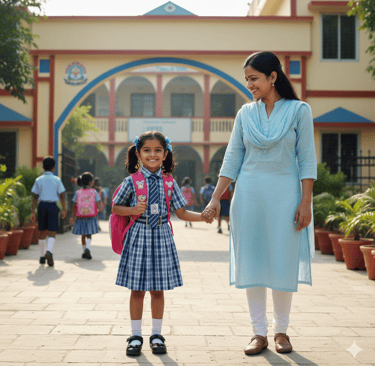
At InuPinu Preschool and Daycare, this philosophy lies at the heart of how we prepare children for their learning journey, by focusing on readiness for life, not just readiness for school.
A widespread myth around school readiness is that children must begin formal writing and reading as early as possible to succeed later. Many parents worry that if their child does not write fluently by the age of four, they may fall behind. However, research in early childhood education consistently shows that pushing children into academic skills before they are developmentally ready can actually hinder long-term learning. NEP 2020 clearly states that early childhood education should focus on play-based, activity-oriented learning rather than rote academics. InuPinu follows this approach by ensuring that children develop the foundational skills required for reading and writing, such as fine motor control, language comprehension, and auditory discrimination, before expecting formal output.
Another common misconception is that sitting quietly, following instructions, and completing worksheets indicate school readiness. While these behaviours may look impressive on the surface, true readiness goes much deeper. Children who are emotionally secure, confident in expressing themselves, and curious about the world around them adapt far more easily to formal schooling. At InuPinu, we observe that children who are encouraged to ask questions, explore independently, and interact freely with peers develop stronger problem-solving skills and social confidence. These are the very qualities that help children thrive when they enter primary school, far more than early worksheet completion ever could.
Language development is also often misunderstood in conversations about school readiness. Many parents assume that readiness means being able to read sentences or write words. In reality, strong language skills begin with listening, speaking, and understanding. A child who can express thoughts clearly, follow stories, ask questions, and engage in conversations is far better prepared for formal literacy learning. InuPinu creates language-rich environments through storytelling, rhymes, conversations, and dramatic play, allowing children to build vocabulary and comprehension naturally. This aligns strongly with NEP’s emphasis on foundational literacy as a gradual and joyful process rather than an early academic race.
Numeracy readiness is another area clouded by myths. Being school ready does not mean solving addition or subtraction problems at a young age. Instead, it involves developing number sense, understanding quantities, patterns, comparisons, and relationships through everyday experiences. At InuPinu, children learn early numeracy concepts through play, hands-on materials, and real-life contexts, such as counting objects, sorting materials, or recognising shapes around them. These experiences build a deep conceptual understanding that supports future mathematical learning in a meaningful way.
Perhaps the most overlooked aspect of school readiness is emotional and social development. A child’s ability to separate comfortably from parents, form trusting relationships with teachers, manage emotions, and interact positively with peers plays a crucial role in how smoothly they transition into formal school. NEP 2020 places strong emphasis on social and emotional learning during the foundational years, recognising that emotional safety is a prerequisite for academic success. InuPinu prioritises nurturing relationships, predictable routines, and a warm, inclusive environment so that children feel secure and confident in their learning space.
Independence is another critical element of readiness that is often underestimated. Simple skills such as managing personal belongings, communicating needs, making choices, and attempting tasks independently prepare children for the structured environment of school. At InuPinu, independence is gently encouraged through daily routines and child-led activities, helping children build self-confidence and resilience. These skills empower children to adapt more easily to new environments and expectations when they move on to primary school.
School readiness, as envisioned by NEP 2020 and practised at InuPinu, is not about how early a child performs academically but about how well they are prepared to learn. When children are emotionally secure, socially confident, curious, and developmentally supported, academic skills follow naturally and with far less stress. InuPinu believes that the early years should be filled with joy, exploration, and meaningful learning experiences, laying a strong foundation not just for school, but for lifelong learning.
For parents navigating the complex and often confusing narratives around early education, understanding the truth about school readiness can be deeply reassuring. By choosing a preschool environment like InuPinu that aligns with NEP 2020 and respects each child’s individual pace, parents can be confident that their child is being prepared in the most thoughtful and effective way possible, not rushed, not pressured, but truly ready.
Kalpanasha Education LLP
Outer Ring Rd, adjacent to Reliance Smart Bazaar, behind Hanuman Temple, Vijaya Bank Colony, Dodda Banaswadi, Bengaluru, Karnataka 560043
Programs
hello@inupinupreschool.com
82969 06303
© 2026. All rights reserved.
Reach Out to us at
Mon-Fri: 9:00 a.m. to 07:00 PM
Sat: 10:00 a.m. to 03:00 PM
Others