Admissions open for 2026–2027. Up to ₹10,000 off for early admissions. Limited seats available

Separation Anxiety in Toddlers: What Helps (And How Parents Can Support)
Watching your child cry when you leave can be one of the hardest parts of parenting. Many parents ask us the same question:
Tip for parents
12/21/20253 min read

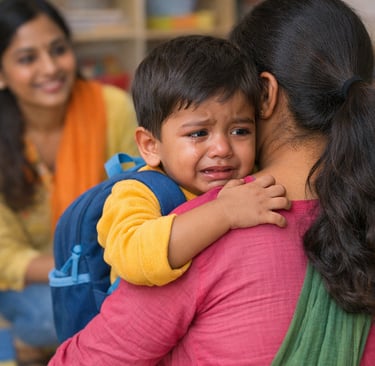
“Why is my child struggling so much to separate?”
The answer is simple, and reassuring: separation anxiety in toddlers is completely normal.
It is not a sign of weakness, bad parenting, or an unsuitable school. It is a sign of attachment, trust, and emotional awareness. And just like every child is different, every child’s settling period is different too.
This blog is written to help you understand what your toddler is feeling, and how you, as a parent, can gently support them through this phase.
What Is Separation Anxiety? Separation anxiety usually appears between 8 months and 3 years, but it can resurface when:
A child starts daycare or preschool
There is a change in routine
The child is away from parents for longer hours
Toddlers don’t yet understand time. When a parent leaves, it can feel permanent to them. Their tears are not manipulation, they are communication. Every Child Settles Differently (And That’s Okay). Some children walk in confidently from day one. Some cry for a few days. Some take weeks to feel fully comfortable.
There is no fixed timeline for settling. Comparing one child to another often creates unnecessary worry. What matters is that your child is slowly building trust, with the environment, the teachers, and the routine.
Progress may look like:
Crying at drop-off but calming down later
Observing quietly instead of participating
Smiling or relaxing after a familiar activity
Forming a bond with one caregiver
All of these are positive signs, even if tears are still present.
How Parents Can Help During the Settling Period
Your role during this phase is incredibly powerful. Here’s what truly helps:
1. Keep Goodbyes Short and Calm
Long, emotional goodbyes can increase anxiety. A simple, confident goodbye tells your child: “You are safe, and I trust this place.” Say goodbye once, clearly, and leave, even if there are tears. Lingering often makes it harder.
2. Talk About School Positively (But Honestly)
At home, talk about daycare or preschool in a warm, reassuring way:
“Your teacher will take care of you.”
“You can play, listen to stories, and have fun.”
“I will come back after your day is over.”
Avoid promises like “I’ll come back very soon” if the child will be there for hours. Honesty builds trust.
2. Talk About School Positively (But Honestly)
At home, talk about daycare or preschool in a warm, reassuring way:
“Your teacher will take care of you.”
“You can play, listen to stories, and have fun.”
“I will come back after your day is over.”
Avoid promises like “I’ll come back very soon” if the child will be there for hours. Honesty builds trust.
3. Build Predictable Routines
Toddlers feel secure when life is predictable.
Try:
A fixed morning routine
Leaving the house at the same time
Using the same goodbye phrase every day
Routine reduces uncertainty, and uncertainty fuels anxiety.
4. Send Comfort From Home
A familiar object can be deeply calming:
A small soft toy
A handkerchief with your scent
A favourite bottle or cloth
These objects act as emotional bridges between home and school.
5. Trust the Teachers (Children Sense It)
Children are incredibly sensitive to parental emotions. If you look anxious, unsure, or guilty, your child feels it too. When parents show trust and confidence in the caregivers, children feel safer letting go.
6. Don’t Sneak Away
Leaving quietly without saying goodbye may seem easier, but it can break trust. When children realise you’ve disappeared, their anxiety often increases the next day. A clear goodbye, even with tears, is healthier in the long run.
7. Avoid “Rescuing” Too Quickly
It’s tempting to pick your child up early or skip days when they cry. While flexibility is sometimes needed, frequent disruptions can prolong the settling process. Consistency helps children adapt faster.
What Schools and Daycares Do to Help?
A supportive early learning environment plays a huge role. Teachers help by:
Offering comfort and reassurance
Engaging children in familiar activities like rhymes and stories
Allowing children to observe before participating
Building one-on-one connections
Respecting each child’s pace
Most children calm down within minutes after parents leave, even if the drop-off felt intense.
When to Be Patient—and When to Pause?
Give your child time. Separation anxiety usually improves with consistency. However, reach out for deeper support if:
Crying worsens over several weeks
The child shows distress even at home
There is withdrawal, fear, or regression
Open communication between parents and teachers is key.
A Gentle Reminder for Parents
Your child is not giving you a hard time. Your child is having a hard time. With patience, reassurance, routine, and trust, separation anxiety fades—and is often replaced by confidence, independence, and joy. This phase will pass. And when it does, your child carries with them a powerful lesson:
“I can be away from my parent, and still feel safe.”
Looking for a Preschool in Vijaya Bank Colony Area or Nearby Areas?
If you’re searching for:
A nurturing Daycare near HRBR Layout, Horamavu, Kalyan Nagar, Kasturi Nagar, OMBR Layout
A play-based, Montessori-aligned Daycare which is safe for your child
A place that values emotional growth as much as academics
InuPinu Preschool and Daycare would love to welcome you.
Because confident children are not pushed, they are gently prepared. 🌱
[separation anxiety in toddlers, toddler crying at daycare, preschool separation anxiety, daycare settling period, toddler missing parents at school, how to help toddler separation anxiety, first day preschool anxiety, toddler emotional development]
Kalpanasha Education LLP
Outer Ring Rd, adjacent to Reliance Smart Bazaar, behind Hanuman Temple, Vijaya Bank Colony, Dodda Banaswadi, Bengaluru, Karnataka 560043
Programs
hello@inupinupreschool.com
82969 06303
© 2026. All rights reserved.

Reach Out to us at
Mon-Fri: 9:00 a.m. to 07:00 PM
Sat: 10:00 a.m. to 03:00 PM

Others