Admissions open for 2026–2027. Up to ₹10,000 off for early admissions. Limited seats available
What Is Phonics Really, And How Does It Fit Into a Child’s English Learning Journey?
Parents today are exposed to a lot of information about phonics. Social media reels, worksheets, and coaching programmes often suggest that phonics is the key to strong English skills. As a result, many parents enrol their children into phonics classes without fully understanding what phonics actually does, how long it should be taught, or whether it addresses their child’s real learning needs.
1/19/20263 min read
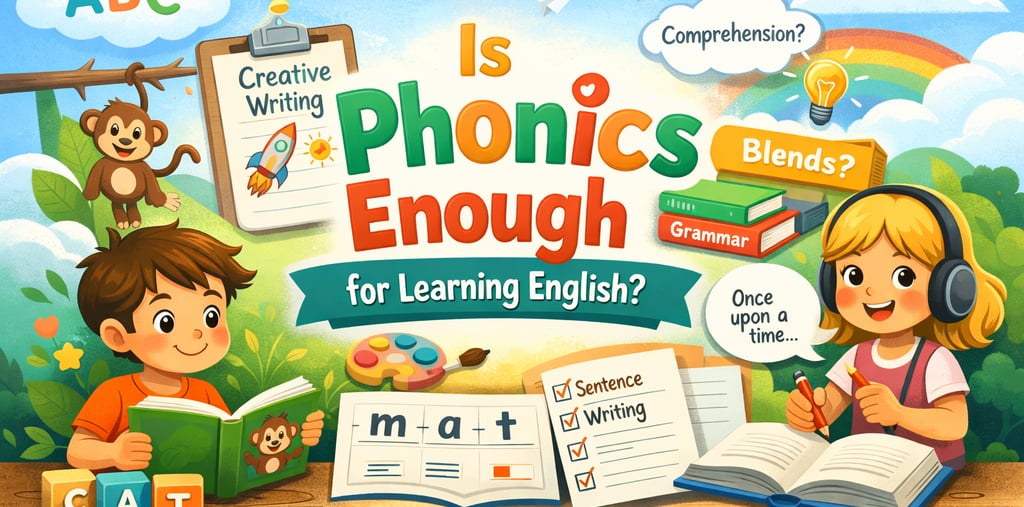
This is where confusion begins, not because phonics is ineffective, but because it is often presented without context. At ELDP (English Learning Development Program), we believe parents deserve clarity, not just content. To make informed choices, it’s important to understand where phonics fits into the overall journey of learning English.
What phonics really does in a child’s learning journey
Phonics is a reading tool. It helps children understand how letters and sounds work together so that they can decode words while reading. This is especially helpful for young learners and for children who struggle to read unfamiliar words confidently.
When phonics is taught well, children stop guessing words. They begin to recognise sound patterns, blend sounds, and approach reading with more confidence. This is why phonics is a valuable part of early English learning.
However, phonics answers only one question for a child:
“How do I read this word?”
It does not answer:
How do I form correct sentences?
How do I express my thoughts clearly?
How do I understand what I read?
How do I write creatively or grammatically?
Those skills require much more than phonics.
Why phonics alone is not enough
One of the biggest misunderstandings around phonics is the belief that it automatically improves spelling, writing, and grammar. In reality, phonics supports reading first, and writing develops through a different process.
Reading is a recognition skill, the word is visible to the child. Writing is a recall skill, the child has to remember spellings, structure sentences, and apply grammar independently. This is why many children can read well but struggle with sentence formation or written expression.
This is not a failure of the child, and it is not a failure of phonics. It simply means the child needs additional language support beyond decoding.
English is a language, not a worksheet system
English learning involves multiple interconnected skills: reading, writing, listening, speaking, comprehension, grammar, and creativity. These skills do not develop at the same pace for every child.
Some children need phonics support early on. Others may already read fluently but struggle to write coherent sentences. Some children have strong vocabulary but lack grammatical accuracy. A fixed, one-size-fits-all programme cannot address these differences effectively.
This is why at ELDP, phonics is one component, not the entire curriculum.
How ELDP approaches English learning differently
The English Learning Development Program (ELDP) is built on a simple belief:
methods should adapt to the child, not the other way around.
Our curriculum includes phonics, blends, reading comprehension, grammar, creative writing, vocabulary development, and oral language, but the focus is never the same for every child. Before deciding what a child needs, we assess:
reading accuracy and fluency,
comprehension and understanding,
sentence formation and grammar usage,
writing confidence,
spelling patterns,
and oral expression.
Based on this assessment, the curriculum is customised. For some children, phonics and blending are essential. For others, the focus shifts to sentence building, grammar in context, or guided writing. This ensures that time and effort are spent on what actually helps the child progress.
How phonics fits into ELDP
In ELDP, phonics is taught:
when a child needs support with decoding,
in a developmentally appropriate way,
with strong emphasis on sound awareness, vocabulary, and oral language,
and never in isolation from reading and comprehension.
For young learners, phonics is introduced slowly and playfully, with ample repetition and language exposure. For older children, phonics may be used selectively to address spelling patterns or reading gaps, but it is never treated as the primary solution for language difficulties.
The role of reading, comprehension, and writing
Regular reading is a core part of ELDP because reading builds vocabulary, sentence awareness, and spelling memory. Comprehension activities help children think about what they read, not just decode it. Grammar is taught through usage and correction rather than rote rule memorisation.
Creative writing and guided writing help children express ideas, organise thoughts, and gain confidence in language. These elements are essential for long-term English proficiency and cannot be replaced by phonics drills.
A simple truth parents should know
If a child cannot read confidently, spelling will feel difficult.
If a child can read but cannot write clearly, phonics is not the missing piece.
Understanding what a child struggles with is more important than choosing a popular method.
Final thoughts: choosing understanding over trends
Phonics is not a trend to be followed blindly, nor is it something to be avoided. It is a valuable tool when used with purpose and clarity. The real challenge lies in understanding when phonics is needed, how much is needed, and what should come alongside it.
At ELDP, our goal is not to rush children through a syllabus but to support their individual language development thoughtfully and responsibly. English learning works best when children feel confident, understood, and guided, not pressured to fit into a method.
When parents understand the why behind learning methods, better decisions follow. And when teaching adapts to the child, real progress begins.
Kalpanasha Education LLP
Outer Ring Rd, adjacent to Reliance Smart Bazaar, behind Hanuman Temple, Vijaya Bank Colony, Dodda Banaswadi, Bengaluru, Karnataka 560043
Programs
hello@inupinupreschool.com
82969 06303
© 2026. All rights reserved.

Reach Out to us at
Mon-Fri: 9:00 a.m. to 07:00 PM
Sat: 10:00 a.m. to 03:00 PM
Others