Admissions open for 2026–2027. Up to ₹10,000 off for early admissions. Limited seats available
Why is it important to Choose Age-Appropriate Toys for Babies and Toddlers?
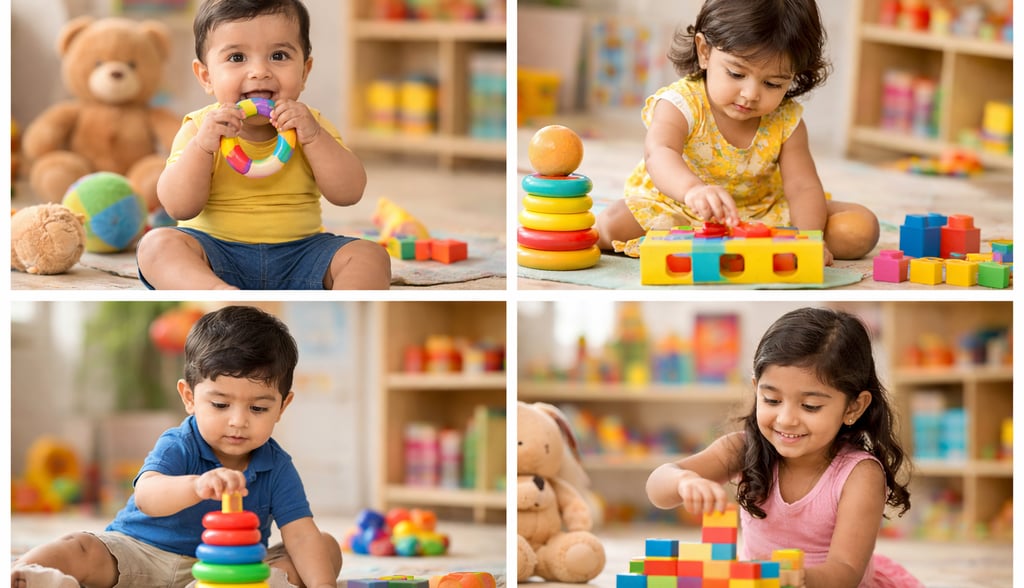
Why the right toy matters more than the number of toys? Walk into any toy store and you’ll see shelves full of bright colours, flashing lights, and big promises, “Boosts IQ!”, “Best for brain development!”. But for babies and toddlers, toys don’t need to be loud or complicated to be valuable. In fact, the best toys are often the simplest ones, those that match a child’s developmental stage and invite them to explore at their own pace. Choosing age-appropriate toys is not about buying more. It’s about choosing better.
12/27/20252 min read
Why Age-Appropriate Toys Matter in Early Childhood
Babies and toddlers learn through their senses—touching, mouthing, stacking, dropping, and repeating. A toy that is too advanced can frustrate them. A toy that is too simple may not hold their interest. Age-appropriate toys:
Support brain development naturally
Build motor skills without pressure
Encourage focus and problem-solving
Reduce overstimulation and frustration
Most importantly, they allow children to learn through play, not performance.
Toys for Babies (0–12 Months)
At this stage, babies are discovering their bodies and the world around them. Everything is new. What to Look For
Soft textures and safe materials
Toys that make gentle sounds
High-contrast colours for visual development
Lightweight toys that are easy to grasp
Best Toy Types
Soft rattles and teethers
Fabric books
Sensory balls
Mirrors designed for babies
These toys help babies develop grip strength, sensory awareness, and early cause-and-effect understanding.
Toys for Young Toddlers (1–2 Years)
This is the age of movement and curiosity. Toddlers love to push, pull, open, and close. What to Look For
Sturdy, safe toys that allow repetition
Simple problem-solving elements
Toys that encourage walking and coordination
Best Toy Types
Stacking rings and cups
Shape sorters
Push-and-pull toys
Large wooden puzzles
At this stage, toys support gross motor skills, hand-eye coordination, and early independence.
Toys for Toddlers (2–3 Years)
Toddlers now want to “do it themselves.” Imagination, language, and emotional understanding begin to grow rapidly. What to Look For
Open-ended toys (no fixed outcome)
Toys that encourage pretend play
Materials that invite creativity
Best Toy Types
Pretend kitchen sets
Dolls and animal figures
Blocks and construction toys
Art materials like crayons and play dough
These toys help build language skills, emotional expression, creativity, and confidence.
Fewer Toys, More Learning
One common misconception is that more toys mean better learning. In reality, too many toys can overwhelm young children. A small, well-chosen toy collection improves concentration, encourages deeper play and reduces overstimulation. Rotating toys every few weeks keeps interest alive without clutter.
Avoid Overstimulating Toys
Toys with flashing lights, loud music, and too many functions often limit creativity. They entertain, but don’t always educate. Simple toys allow children to:
Use imagination
Control the pace of play
Learn through trial and error
Safety Always Comes First
When choosing toys, always check for non-toxic materials, no sharp edges or small detachable parts and age labels on packaging. For babies and toddlers, safety is learning.
How We Choose Toys at InuPinu Preschool and Daycare
At InuPinu Preschool and Daycare in Dodda Banaswadi, toys are chosen with intention. We focus on materials that support developmental milestones, emotional growth, and independent exploration. Our learning spaces are designed to feel calm, inviting, and purposeful—where toys are tools for discovery, not distraction. Because when toys match a child’s stage of development, learning feels natural and joyful.
A Gentle Reminder for Parents
You don’t need expensive toys. You don’t need the latest trends. What your child needs most is time, freedom, and thoughtful choices. The right toy doesn’t entertain your child, it empowers them.
Kalpanasha Education LLP
Outer Ring Rd, adjacent to Reliance Smart Bazaar, behind Hanuman Temple, Vijaya Bank Colony, Dodda Banaswadi, Bengaluru, Karnataka 560043
Programs
hello@inupinupreschool.com
82969 06303
© 2026. All rights reserved.
Reach Out to us at
Mon-Fri: 9:00 a.m. to 07:00 PM
Sat: 10:00 a.m. to 03:00 PM
Others