Admissions open for 2026–2027. Up to ₹10,000 off for early admissions. Limited seats available
Why Open-Ended Toys Are Better Than Flashy Toys
A parent’s guide to choosing toys that truly support early learning and emotional growth. Walk into any toy store today and you’re met with shelves full of bright lights, loud sounds, buttons, screens, and bold claims. Toys promise to teach alphabets, numbers, colours, and even “boost intelligence”, all at the press of a button.
12/29/20254 min read
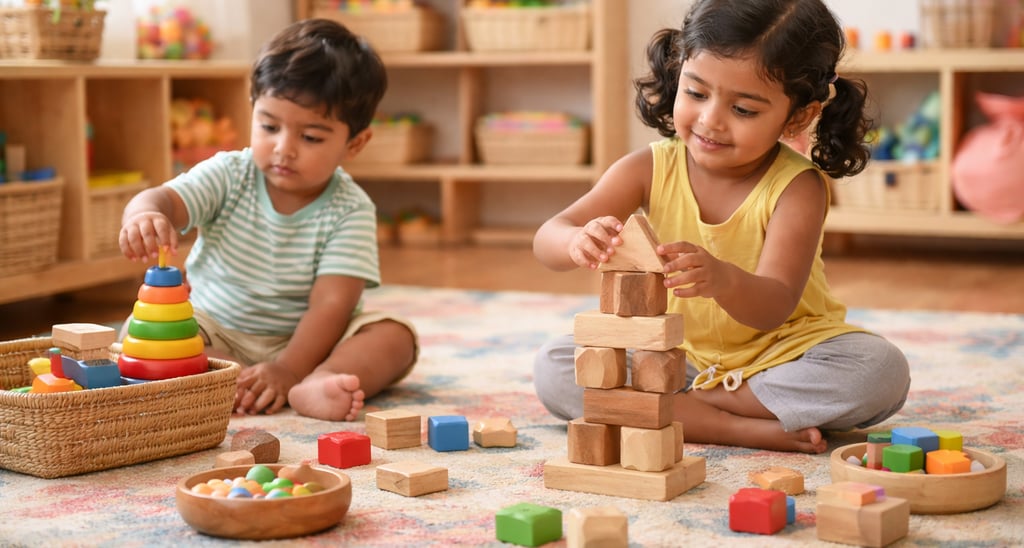
It’s easy for parents to feel confused. If a toy can talk, sing, and light up on its own, surely it must be better than a simple wooden block or a plain set of stacking cups. But in early childhood, more stimulation does not mean more learning.
At InuPinu Preschool and Daycare in Dodda Banaswadi, Bangalore, we see a clear difference every day between how children engage with open-ended toys and how they respond to flashy, electronic ones. The difference is not subtle. It shows up in attention span, creativity, emotional regulation, and even confidence.
What Open-Ended Toys Really Mean
An open-ended toy is one that does not tell a child what to do or how to play. It does not have a fixed goal, a single correct outcome, or a pre-programmed response. A set of wooden blocks can become a tower, a road, a house, or a bridge. A simple cloth doll can be a baby, a friend, or a character in a story. The toy stays the same, but the play changes, because the child leads it. This is very different from flashy toys that light up, talk, and perform the moment a button is pressed. In those toys, the action comes from the toy itself. In open-ended toys, the action comes from the child.
How Flashy Toys Limit Real Learning (Even When They Look Impressive)
Flashy toys are designed to entertain quickly. They grab attention, hold it briefly, and often overwhelm the senses with sound and movement. While this may look engaging from the outside, it often turns the child into a passive observer rather than an active participant. Over time, children can become dependent on external stimulation. They wait for the toy to do something instead of imagining what they could do with it. Play becomes short-lived and repetitive. Once the novelty wears off, interest drops, and the toy is abandoned. In contrast, open-ended toys grow with the child. A toddler may stack blocks today, line them up tomorrow, and build elaborate structures a year later using the very same set.
Why Open-Ended Toys Support Brain Development Better
Young children learn best when they are actively involved. When a child decides how to use a toy, their brain is working across multiple areas at once, planning, problem-solving, decision-making, and emotional regulation. Open-ended toys encourage children to:
Think creatively
Experiment without fear of failure
Solve problems independently
Stay engaged for longer periods
This kind of deep play strengthens neural connections far more effectively than toys that simply respond with lights and sounds.
The Emotional Side of Play That Parents Often Miss
Play is not just about skills. It is also how children process emotions. With open-ended toys, children can act out experiences, express feelings, and make sense of their world. A child who feels unsure may build and rebuild the same structure repeatedly. A child processing separation may play family games with dolls or animals. These moments help children regulate emotions in a safe, natural way. Flashy toys rarely offer this space. They dictate the interaction, leaving little room for emotional expression or imaginative exploration.
Attention Span, Focus, and Calm Play
One of the most noticeable differences between open-ended and flashy toys is how long children stay engaged.
At InuPinu Preschool near HRBR Layout, Kalyan Nagar, Kasturi Nagar, Horamavu, and OMBR Layout, we consistently observe that children playing with open-ended materials remain focused for longer periods. Their play is quieter, deeper, and more purposeful. Flashy toys often lead to short bursts of excitement followed by restlessness. Children move quickly from one toy to another, seeking the next stimulation. Open-ended play supports calm concentration, an essential skill for school readiness and emotional balance.
Fewer Toys, Deeper Play
Many parents believe that having more toys means better learning opportunities. In reality, too many toys, especially overstimulating ones, can overwhelm young children. Open-ended toys work beautifully in smaller numbers. When children have fewer choices, they explore each one more deeply. They return to the same toy with new ideas, building familiarity, mastery, and confidence. This is why many high-quality preschools and Montessori-inspired environments intentionally keep toy selections minimal and purposeful.
Safety, Simplicity, and Longevity
Open-ended toys are often made from simple, durable materials like wood, cloth, or natural fibres. They tend to last longer, age better, and pose fewer sensory and safety concerns compared to battery-operated toys. They are also easier to rotate and reuse, making them a sustainable and thoughtful choice for families.
How We Choose Toys at InuPinu Preschool and Daycare
At InuPinu Preschool and Daycare in Dodda Banaswadi, toy selection is intentional. We choose toys that invite imagination, support independence, and encourage children to lead their own play. Our classrooms are designed to feel calm and inviting, not noisy or overwhelming. This allows children to explore confidently, engage deeply, and learn naturally, without pressure or performance. We see daily proof that when children are given the right tools, they don’t need to be entertained. They discover, create, and grow on their own.
A Gentle Message for Parents
You don’t need the most expensive toys. You don’t need the ones with the most features. What your child needs most is time, space, and the freedom to explore. A simple toy, in the hands of a curious child, is far more powerful than a flashy toy that does all the work for them. When play is led by the child, learning follows naturally.
Thinking Ahead About Preschool and Daycare Choices?
If you’re exploring preschool or daycare options in Dodda Banaswadi or nearby areas and value calm, meaningful learning over overstimulation, we invite you to visit InuPinu Preschool and Daycare. Our approach respects childhood, supports emotional safety, and prepares children for school, without rushing them.
✨ Admissions open for the upcoming academic year
📍 Dodda Banaswadi, Bangalore
📞 Call or WhatsApp to schedule a visit : 8296906303
Because the best learning doesn’t come from noise and lights, it comes from curiosity, confidence, and thoughtful play.
Kalpanasha Education LLP
Outer Ring Rd, adjacent to Reliance Smart Bazaar, behind Hanuman Temple, Vijaya Bank Colony, Dodda Banaswadi, Bengaluru, Karnataka 560043
Programs
hello@inupinupreschool.com
82969 06303
© 2026. All rights reserved.
Reach Out to us at
Mon-Fri: 9:00 a.m. to 07:00 PM
Sat: 10:00 a.m. to 03:00 PM
Others